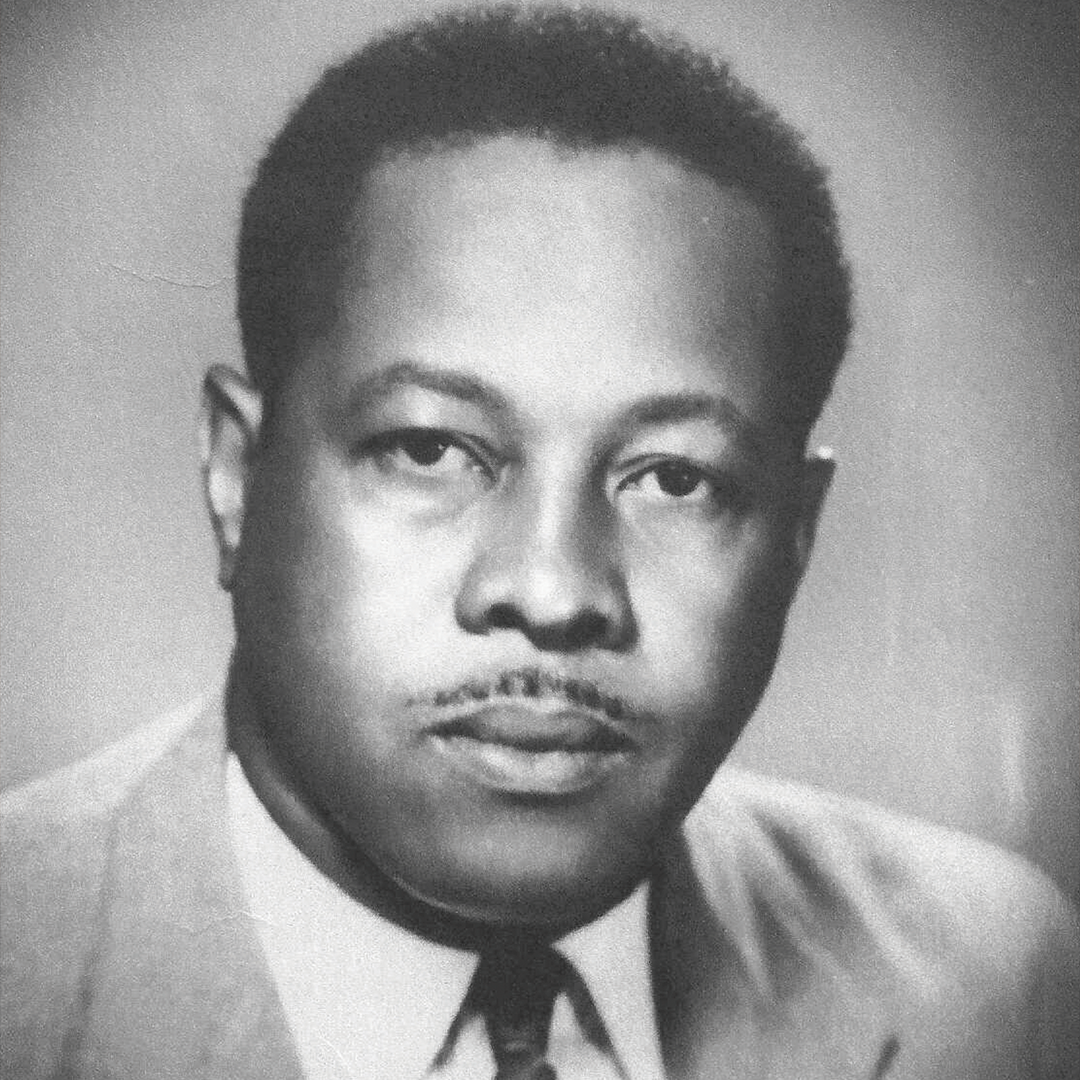
A Name Among the Memorials
In December 1967, the Texas Bar Journal published its customary memorials for attorneys who had recently died. Among them, beside long-time practitioners from Dallas and Tyler, was a short entry for Kenneth R. Lamkin, Sr., an Austin attorney and civic leader who died on Sept. 9, 1967, at the age of 59.
The entry did not mention what makes Lamkin significant to this association’s history. He is believed to have been the first African American member of the Travis County Bar Association, known today as the Austin Bar Association. And the brief closing line noting that he was survived by his wife gave no hint that she was a figure of note in her own right: Cathryn Caviness Lamkin, whose only screen role is preserved in the Library of Congress’s National Film Registry.
The Road Before Him
Lamkin was not the first Black lawyer to practice in Austin, and his story is best understood as part of a longer one. In the early 1880s, John N. Johnson, a schoolteacher turned attorney, became Austin’s first African American lawyer. As Justice John G. Browning recounts in his 2021 State Bar of Texas paper on Johnson, he was admitted to practice before the Supreme Court of Texas on Feb. 9, 1883, the first person of color to gain that privilege.
Johnson filed some of the state’s earliest civil rights lawsuits, challenging segregated rail accommodations. In the 1883 murder case of his client Perry Cavitt, he argued that the exclusion of Black citizens from the jury violated the Fourteenth Amendment’s guarantee of equal protection. He also edited The Austin Citizen, a newspaper serving Austin’s African American community.
Yet the doors Johnson pushed open did not stay open wide. Browning notes that as late as 1930, there were only twenty Black attorneys in all of Texas. That was the profession Kenneth Lamkin set out to join.
From Gonzales County to the Bar
Kenneth Romel Lamkin was born on April 23, 1908, in Gonzales County. He attended public schools in Luling and Yoakum, then earned a Bachelor of Arts degree from Austin’s Samuel Huston College, a forerunner of today’s Huston-Tillotson University, in 1930.
The University of Texas School of Law did not admit Black students in those years, so Lamkin found another way. He studied law through LaSalle Extension University, a correspondence program, and read law in the private office of Austin attorney Mrs. Anna I. Sandbo. He was admitted to the bar in 1939 and practiced in Austin for the rest of his life, a career of nearly three decades.
A First for the Travis County Bar
Lamkin is believed to have been the first African American member of the Travis County Bar Association. Exactly when he joined is uncertain, but he was a member by 1947. His photograph and name appear among the association’s 1947 members in a framed display that hangs today in the Austin Bar Association office. He joined at a time when Austin’s public life was still divided by law and custom, and years before Black students were admitted to the University of Texas School of Law.
His membership meant a seat among colleagues who had long practiced without him, and a measure of standing for every Black client he represented in Travis County’s courts.
In the Courtroom
Lamkin’s work reached the state’s highest criminal court. In Lamkin v. State, 301 S.W.2d 922 (Tex. Crim. App. 1957), he and Austin attorney Joe B. Fleming represented Marshall Lamkin, a Black defendant convicted of murder in Caldwell County and sentenced to death. (The opinion does not indicate whether the two men were related.)
Among the grounds raised on appeal, the defense moved to quash the indictment, arguing that Caldwell County’s jury commissioners had systematically excluded Black citizens from grand jury service. The Court of Criminal Appeals rejected the claim, noting that one member of the grand jury was Black and finding the evidence insufficient to prove systematic discrimination. The conviction was affirmed, and rehearing was denied on May 1, 1957.
The case lost, but the argument carried a long history. More than seventy years earlier, John N. Johnson had raised the same challenge to all-white juries on behalf of Perry Cavitt. Lamkin stood in that same line of advocates, pressing the courts to make equal protection real for Black defendants.
Civic Leader, Editor, and Author
Outside the courtroom, Lamkin was among East Austin’s most active leaders. He served as president of the Negro Citizens Council, the Austin NAACP, the Negro Junior Chamber of Commerce, and the East Austin Council on Community Affairs. He was a charter member of the Capital City Lions Club, a member of the Karl E. Downs Student Loan Fund, and a 33rd degree Mason and Shriner.
His civil rights work drew national notice. He helped the City of Austin organize a local civil rights commission, and in 1966 President Lyndon B. Johnson appointed him a delegate to a national civil rights conference in Washington, D.C.
Like John N. Johnson before him, Lamkin understood the power of the press. He was part owner and editor of The Capital City Argus, a community newspaper. He also wrote two books that remained unpublished at his death, In the Beginning and Dis Heavy Load.
Cathryn Caviness Lamkin: A Star in Her Own Right
Lamkin’s wife was born Catherine Bonita Caviness on April 30, 1914, in San Antonio, one of twelve children of John Henry Caviness and Lena Alice Kruse Caviness. Like her husband, she graduated from Samuel Huston College.
In 1941, billed as Cathryn Caviness, she starred in The Blood of Jesus, written, directed, and produced by Spencer Williams, who later became famous as Andy on television’s Amos ’n’ Andy. She played Martha, a devout rural woman who is accidentally shot by her husband and, hovering between life and death, is restored through faith. The film was one of the celebrated “race films” made by and for Black audiences during the Jim Crow era.
The Blood of Jesus was long presumed lost until a print was rediscovered in the late 1980s in a warehouse in Tyler, Texas. In the early 1990s, the Library of Congress selected it for the National Film Registry. A 2017 UCLA exhibition on African American women in race films praised the tenderness of her performance, noting that it was her only professional film role and that little was known about her life.
Austin knew her well. She worked as a program director with the City of Austin’s Recreation Department. On Dec. 9, 1960, she became a charter member of the Austin Chapter of The Links, Incorporated, the national service organization of professional women of color, organized at the East 13th Street home of Lillie Belle Hines. She died at her home in Austin on Aug. 30, 1993, at the age of 79.
A Legacy Worth Remembering
Kenneth R. Lamkin, Sr., died on Sept. 9, 1967, survived by his wife and their son, Kenneth R. Lamkin, Jr., who is understood to still live in Texas. Cathryn lived another 26 years, carrying forward a life of service in the city they shared.
Together, the Lamkins represent a generation that built institutions where few had been allowed to enter. He opened the door of this association to lawyers of color. She brought dignity and artistry to a film now counted among the nation’s cultural treasures, then devoted her later years to Austin’s young people and community life.
Nearly 30 years after Lamkin’s death, the door he opened led to the association’s highest office. In 1996, the Rev. Joseph C. Parker, Jr., became the first African American president of the Travis County Bar Association.
The Austin Bar Association is today a richer and more representative body. As we mark its history, it is fitting to remember the attorney who first walked through its doors, and the remarkable woman who walked beside him.