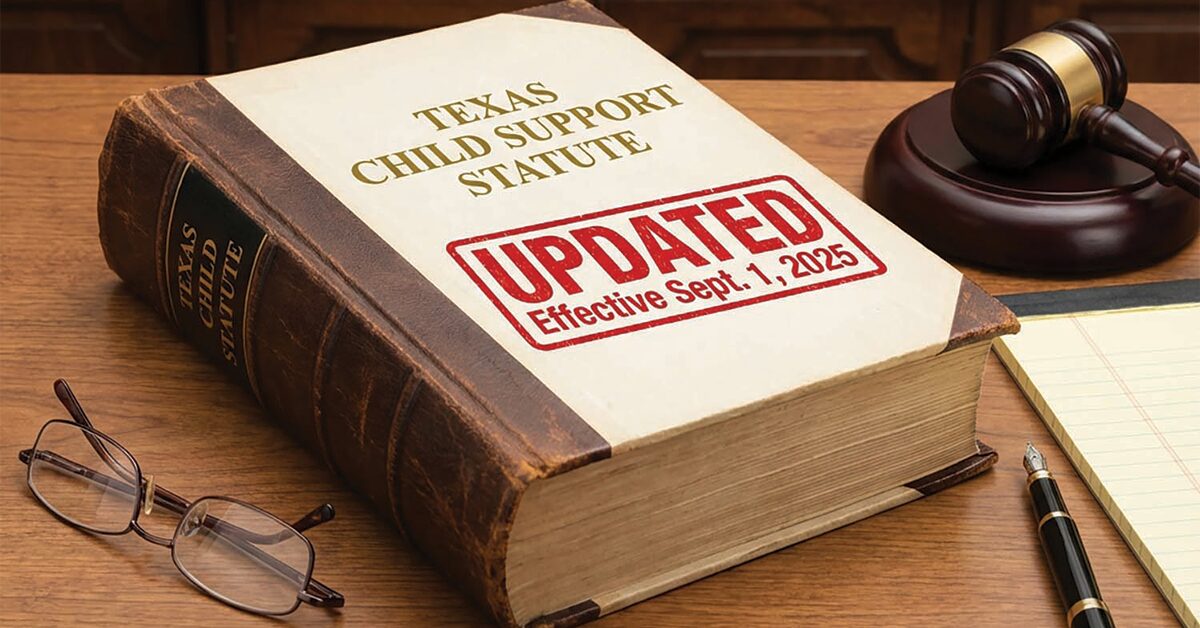
Texas recently rewrote essential parts of its child support statutes, and the changes carry real consequences for families across the state. As of Sept. 1, 2025, the Texas Family Code increased the income cap used to calculate guideline child support and adjusted how certain cases move through the system.¹
Since 2019, Texas has capped monthly net income at $9,200 when calculating child support. It didn’t matter if a parent earned more. The guideline stopped there. As of September 1st of last year, the cap has been raised to $11,700 per month, raising the maximum guideline obligation for one child from $1,840 to about $2,340 each month.²
That shift tracks the rising cost of raising children in Texas. Childcare, housing, insurance, and groceries don’t pause for outdated statutes. Still, the increase lands hard for many parents. Hundreds of dollars a month can mean the difference between staying current and sliding into enforcement. I see that pressure play out weekly in Austin-area cases.
Here’s the part many families miss. The term “net income” can be misleading as it is not a full deduction of a person’s various personal expenses. The net income does not deduct items such as rent, 401(k) contributions, food, or car payments, and there are certain statutory tax deductions. Existing orders do not automatically adjust to the new numbers. To apply the updated cap, someone must file a modification and prove a qualifying substantial and material change in circumstances. That means more filings, more hearings, and more expense layered onto families already stretched thin.
The revisions don’t stop at money. Recent changes to standing rules have narrowed who can initiate or participate in custody cases. Step-parents, long-term caregivers, and non-biological parents now face steeper hurdles before a court will even hear them.³ For blended families, common across Texas, these rules reshape who gets a voice when decisions about children are made.
Supporters call these changes cleaner and more predictable. From a statutory standpoint, they may be. From a human standpoint, predictability does not always equal justice, and statutes rarely account for lived reality. Statutes can’t account for every situation, which can be tough in an individual case with unique facts. Parents certainly have the right and responsibility to decide who has access to their children. However, that concept is challenged when adults who have had access to or relationships with children are suddenly cut off, and they don’t have any recourse.
The outcomes of family law cases are rarely “fair.” One person’s version of “fair” is often the other side’s version of “unfair.” Courts apply formulas, thresholds, and evidence. They don’t balance emotional scales. Parents who understand this early tend to make better decisions and suffer fewer long-term consequences.
Here’s what Texas families should understand right now. Know your numbers before someone else does, because if your income sits near or above the new cap, your financial exposure has likely changed. Nothing changes unless someone files, and orders signed before September 2025 remain in place until a modification is granted, which means delay can work for or against you. Time matters, and waiting too long to respond can turn a manageable adjustment into enforcement action, arrears, or wage withholding.
I don’t write this to scare parents. I write it because the silence around statutory changes leaves families blindsided. Laws should not function like traps. If Texas wants stronger families, it needs clearer education alongside stricter rules.
Understand the system as it is, not as you wish it worked. That knowledge doesn’t solve everything, but it keeps you from being surprised by outcomes you never saw coming.
ENDNOTES
1 New Texas Family Laws Transform Navigating Divorce and Custody, Best Lawyers.
https://www.bestlawyers.com/article/new-texas-family-laws-transform-navigating-divorce-custody/7108
2 Texas Child Support Calculations: What You Need to Know, Paralegal Texas.
https://paralegaltexas.com/blog/texas-child-support-calculations
3 Texas Legislature, HB 2350 Bill Analysis (89th Legislature) – changes to standing in certain family law proceedings.
https://capitol.texas.gov/tlodocs/89R/analysis/pdf/HB02350E.pdf